
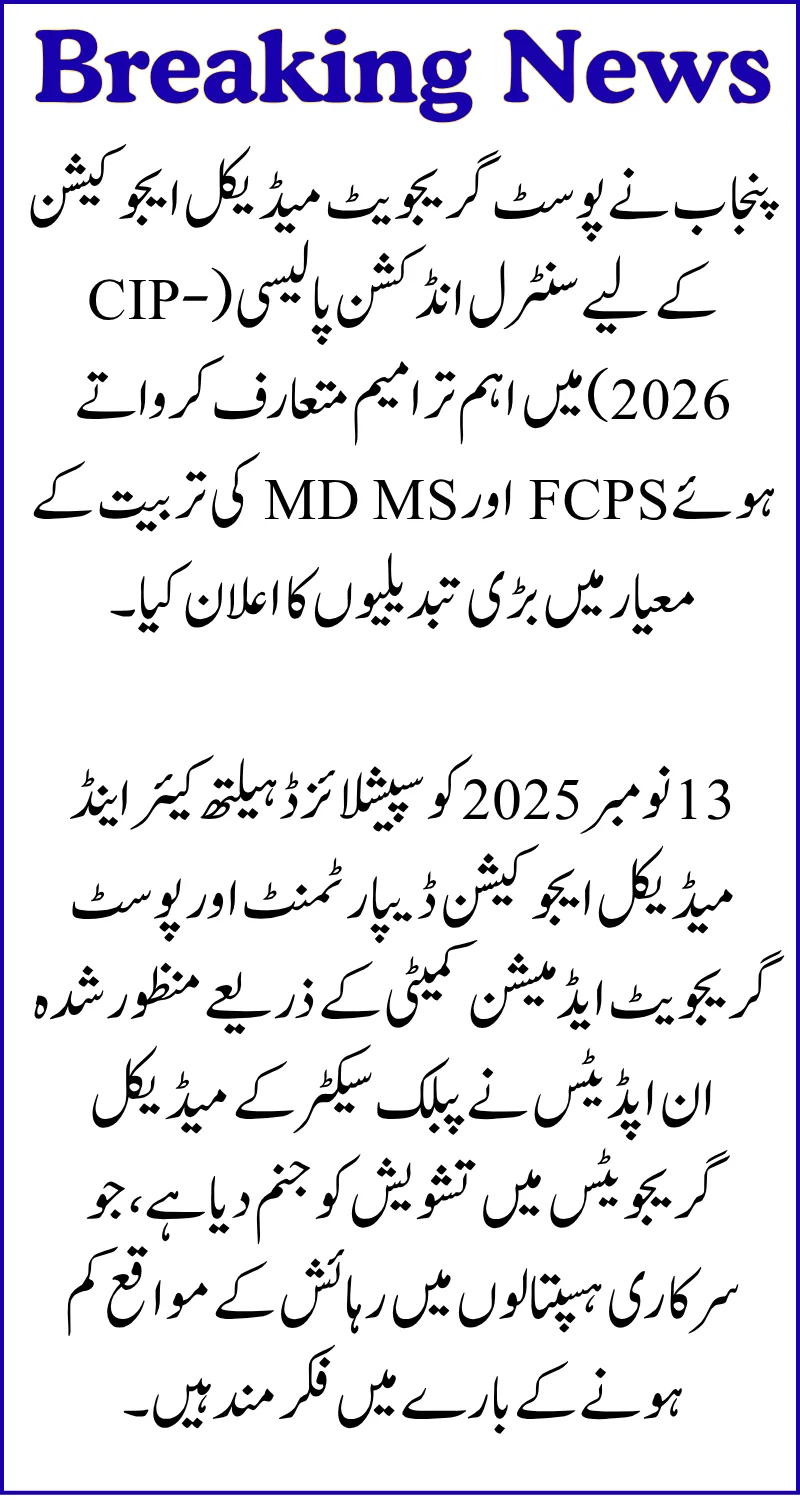
Punjab announces major changes to FCPS and MD MS training criteria, introducing significant revisions in the Central Induction Policy (CIP-2026) for postgraduate medical education.
These updates, approved by the Specialized Healthcare & Medical Education Department and the Postgraduate Admission Committee on November 13, 2025, have sparked concern among public-sector medical graduates, who worry about reduced opportunities for residency placements in government hospitals.
Overview of CIP-2026 and Key Revisions
The CIP-2026 policy revises the merit structure for FCPS and MD/MS training programs across Punjab. Under this new framework:
- Experience-based marks for government medical graduates have been reduced by up to 50% for the January 2026 induction.
- For the July 2026 cycle and subsequent intakes, all experience-based marks are eliminated entirely.
- Points previously awarded for parent institute affiliation, house jobs, and Matric/FSc marks have been removed.
These changes are intended to standardize merit evaluation but have raised concerns about fairness for public-sector graduates who previously benefited from experience in underserved areas.
Also Read: CM Distributed Punjab Rashan Card Program to People Step-by-step Guide
Detailed Breakdown of Training Marks
Previously, candidates received:
- 10 marks for service at BHUs, RHCs, THQs, DHQs, and PESSI hospitals
- Up to 15 marks for work in jail hospitals
Under CIP-2026:
- January 2026 cycle:
- 1.25 marks for every uninterrupted 3 months at BHUs and RHCs
- 0.75 marks for service at THQs, DHQs, PESSI hospitals (100+ beds)
- 0.5 marks for experience at major tertiary hospitals (e.g., Pakistan Kidney and Liver Institute, Multan Institute of Kidney Diseases)
- July 2026 onwards: Experience-based marks will no longer be granted
This shift drastically reduces the recognition for doctors who have served in rural and primary healthcare settings, creating concerns about equitable access to postgraduate training.
Also Read: Benazir Hunarmand Program 2025 Registration – Apply To Get Skill
Impact on Public vs Private and Foreign Graduates
Critics argue that the policy changes favor private and foreign medical graduates, reducing the advantage previously held by public-sector graduates. Public medical college doctors fear that:
- They may have fewer opportunities to secure residency seats in government hospitals.
- Merit distribution could increasingly favor non-government graduates, especially in competitive specialties.
These changes have prompted intense discussions on social media and professional forums, highlighting the widespread anxiety among young doctors.
Removal of Additional Points and Institutional Preference
CIP-2026 also removes:
- Parent institute affiliation points
- House job completion points
- Matric/FSc marks
This elimination of institutional preference is seen by many as a significant setback, particularly for graduates hoping to train at their parent medical colleges. The rationale, according to officials, is to create a level playing field between government and private college graduates.
Read More: CM Punjab Solar Panel Scheme 2025 December Distribution Begins for Phase 3
Official Statements and Clarifications
Prof Ahsan Waheed Rathore, Vice Chancellor of the University of Health Sciences (UHS), clarified that the policy is not discriminatory. He emphasized:
- The revised merit structure provides equal opportunity to candidates from both government and private institutions.
- Matric and FSc marks should not influence postgraduate placement once MBBS is completed.
- The changes aim to modernize the evaluation system while maintaining transparency in the residency selection process.
Future Implications for Medical Graduates
The CIP-2026 revisions may have long-term effects on postgraduate training:
- Public-sector graduates need to strategize for merit points differently.
- Young doctors should focus on specialty choices and other competitive factors.
- Institutions may adapt policies or offer guidance to ensure fair opportunities for underserved doctors.
Overall, awareness and preparation will be crucial for navigating these new criteria effectively.
Also Read: CM Punjab E-Bike Scheme 2025 Online Apply Deadline Announced- Full Guide
FAQs About FCPS and MD MS training Criteria
What are the major changes in CIP-2026 for FCPS and MD/MS training?
Experience-based marks, parent institute points, house job points, and Matric/FSc marks have been reduced or eliminated, affecting merit calculation.
How do January 2026 and July 2026 induction cycles differ?
January 2026 allows reduced experience marks, while July 2026 onwards removes all experience-based marks.
Are public-sector graduates disadvantaged under the new policy?
Critics argue yes, because previous advantages for government medical college graduates have been significantly reduced.
Why were Matric, FSc, and parent institute marks removed?
Officials state these components are no longer relevant for postgraduate induction once MBBS is completed, ensuring equal opportunity for all candidates.
Conclusion
The announcement that Punjab announces major changes to FCPS and MD MS training criteria represents a significant overhaul of the postgraduate medical training system. While intended to standardize merit evaluation.
These changes have profound implications for public-sector medical graduates, particularly those who have served in rural and primary care settings. Understanding the CIP-2026 policy, its revised merit structure, and future implications is essential for MBBS graduates planning their FCPS or MD/MS career paths in Punjab.